
Yuai World Foundation
世界友愛基金會

Global Student Exchange
Global Talent Development
Global Talent Development
Building Bonds and First-Time Wonders: A Report from Six Austrian Exchange Participants. The 2024 OEJAB delegates departed from Haneda Airport on Saturday, March 1st, and returned safely on Monday, March 10th. Each participant has compiled a report of their unique experiences, accompanied by photos they took themselves, complete with captions. We are pleased to share these accounts of their journey through Austria.A significant highlight of this exchange was the involvement of members who had come to Japan as OEJAB delegates last year; they joined the program as guides in Austria, fostering a new dimension of cross-cultural connection. The following pages present the six participants' stories, arranged in the Japanese alphabetical order (a-i-u-e-o). An asterisk (*) in a caption denotes an editorial note.
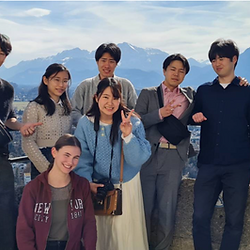

Fifth-year medical student at Chiba University

Second-year Master’s Student, Hokkaido University

Third-year student in the Faculty of Integrated Human Studies at Kyoto University

Masaya Suguro, Fourth-year Student, Department of Humanities and Culture, University of Tsukuba

Sixth-year student in the Faculty of Medicine, Tokyo University of Science

Fourth-year Student, Faculty of Letters, The University of Tokyo
Growing Through Experiences and Dialogue
Yuta Iwaoka, fifth-year medical student at Chiba University
Our first meal after arriving in Vienna was lunch together at a café. Despite being called a café, the place had high ceilings and a spacious atmosphere—more fitting to be called a restaurant. I remember feeling nothing but excitement as I enjoyed my very first meal in Europe.
Austrian cafés, I learned, once served as open meeting places where scholars and intellectuals freely exchanged ideas and information. In that sense, they functioned almost like informal academic conferences. During this trip, too, I was able to engage with many people from different academic fields and backgrounds, including my six fellow participants. Of course, our experiences at OEJAB and the United Nations offered us tremendous learning opportunities. Yet, what I value most from this program is not only those formal visits, but also the encounters and discussions we shared with diverse individuals—much like the lively exchanges that once flourished in Austria’s café culture.
Our main destination, OEJAB, operates four major programs: nursing homes, student dormitories, hotels, and vocational training schools. We learned about the organization’s comprehensive system of care and the wide range of social welfare activities provided at each facility. OEJAB maintains its operations by balancing profits and losses among these sectors—using, for instance, revenue from student housing to support less profitable services. By running multiple projects in parallel, the organization has established a sustainable model that delivers high-quality welfare.
The interconnection among these programs extends beyond financial management. The student dormitories, for example, are not merely places to live; they provide opportunities for residents to study German and information technology, and to participate in community activities such as soccer teams. These experiences foster both education and solidarity among young people. Some former dorm residents even express the wish to live together again in OEJAB’s nursing homes in the future—evidence of the lasting human bonds cultivated there. I was deeply impressed by how OEJAB, as a single organization, offers a lifelong continuum of welfare and support. It gave me valuable insight into how Japan’s own medical and welfare systems might evolve in the years to come.
Beyond these formal visits, we also made many unforgettable memories—touring UN facilities, visiting the Permanent Mission of Japan, and spending relaxing time by the river in Salzburg. Thanks to Nick, who attended to us throughout the trip, and our friends in Vienna who guided us every day, the journey became even more fulfilling and meaningful.
Finally, I would like to take this opportunity to express my sincere gratitude to everyone who made this experience possible—OEJAB, the Yuai organization, and all those who supported and accompanied us along the way. Thank you very much.
Encounters through the OEJAB Program
Natsuno Oda, Third-year Student, Faculty of Integrated Human Studies, Kyoto University
For me, what leaves the deepest impression when I travel is always the people I meet. This trip to Austria, full of meaningful encounters, became truly unforgettable. In addition to the five fellow delegates who traveled with me, I had the opportunity to meet many others—the Austrian students who visited Japan last year, staff and residents of OEJAB’s dormitories and nursing homes, people at the Federal Chancellery, and many more. Listing every encounter from those ten days would be impossible.
I believe that meeting people is so important because human imagination has its limits. Even though most information is available online today, what we can truly imagine from a screen is very restricted. For instance, before this trip, I had read about the importance of social integration for immigrants, the role of language education, and the effectiveness of vocational training—all topics you can find in textbooks. However, when I actually visited the sites and met the people working there every day, those concepts stopped being mere information. Seeing vocational training in practice—glasswork, plumbing, bicycle repair—and attending German language classes filled with students of various ages and backgrounds turned abstract phrases like “vocational training programs for immigrants” or “Ukrainian refugees with children” into vivid, tangible realities.
Meeting people involved in promoting social integration from various perspectives—at OEJAB facilities and the Federal Chancellery—also deepened my awareness of immigration issues in Japan. Although the number of foreign workers in Japan is increasing, I feel that the idea of immigrant integration as a shared social issue has not yet become widespread. One message that we repeatedly heard at both OEJAB headquarters and the Federal Chancellery was that promoting social integration is not only for the benefit of immigrants, but for the benefit of society as a whole. In a time when exclusionary attitudes and opposition to using public funds for foreigners are becoming more visible, I was reminded of the importance of facing these realities and seeking practical solutions rather than turning away from them.
Finally, I am deeply grateful to Yuai and OEJAB for providing such opportunities to students like myself, who still lack professional experience and skills. I believe this is because they see our potential to contribute to society in the future. During the program, I was inspired by OEJAB staff members and UN interns who were close to my age and already playing active roles in their fields. Motivated by their example, I am determined to continue learning so that I, too, can one day give back to society. I would like to express my heartfelt gratitude to Yuai and to everyone who supported and guided me throughout this invaluable experience.
Anchoring My Resolve — Lessons from Austria
Yumi Kijima, Sixth-year Medical Student, Tokyo University of Science
The ten intensive days I spent in Austria with my fellow participants were filled with encounters and new perspectives that reignited my sense of purpose. Among the many valuable experiences, two in particular left a deep impression on me.
The first was our visit to OEJAB facilities, including refugee support centers, vocational training schools for young people (BFP), and nursing homes. When we asked about the backgrounds of the BFP students, the staff mentioned various challenges they faced—psychological and social difficulties, experiences of bullying, and family issues such as substance abuse. What struck me most, however, was that “immigrant and refugee issues” came up immediately as a major concern. In a country where about one-fourth of the population has an immigrant background, this seemed uniquely characteristic of Austria.
When I joined a German language class (German being Austria’s official language), the students warmly and cheerfully helped me learn, and I could feel how the OEJAB program provided them with a sense of safety and self-worth. Later, when I mentioned that Japan struggles with a shortage of welfare workers, the OEJAB leadership told us that Austria faces the same problem—and that they actively recruit immigrants to work in their care facilities as part of the solution. I was deeply impressed by OEJAB’s approach, in which immigrant and refugee support is directly linked to addressing the labor shortage in the welfare sector. It made me realize that in Japan as well, where the number of foreign workers is increasing, supporting immigrants and refugees could also offer hope for solving workforce challenges.
The second memorable experience was our visit to UN organizations. Meeting UN staff members and interns completely changed my perception of the organization. To be honest, before this visit, the United Nations had seemed distant—something far removed from my own possible career path. However, meeting a young staff member from Brazil who speaks nine languages (including Japanese!) and an intern from Asia who was around my age, I was both astonished and inspired. I felt a strong pull toward the idea of working alongside people like them to tackle global challenges. Thanks to this program, a new dream has taken root within me—to one day return to Vienna as a UN staff member.
I am filled with gratitude to everyone who made this incredible opportunity possible: the Yuai Foundation, Nick who supported us throughout our stay, and all the people I met during the program. The ideals I encountered in Vienna have become an anchor in my heart—something I will return to whenever the waves of life begin to sway me. Holding onto this “anchor,” I hope to continue moving forward toward my dream of never giving up on the happiness of each and every person.
If Only I Had Joined the Program Three Years Earlier…
Taichi Sasaki, Second-year Master’s Student, Hokkaido University
I can’t help but feel how wasteful my university life has been up until now. During my time in Austria, that realization struck me deeply.
In the essay I wrote before the trip, outlining my goals for the OEJAB program, I wrote about my hopes to exchange knowledge with the other participants—bright, capable individuals from various fields. However, this expectation was pleasantly betrayed: in truth, I received far more knowledge from my peers than I was ever able to offer them.
The most striking example was the sheer difference in our knowledge about Austria and Europe in general. Although none of the other participants specialized in Austrian studies, they were remarkably well-versed in Austrian history, architecture, and art movements. Despite being around the same age, the difference in cultural literacy was undeniable. But what I learned from them wasn’t limited to academic knowledge—it was also about their attitudes toward learning itself.
For instance, when I studied English, my motivation was mostly extrinsic: passing university entrance exams or improving my TOEIC score. In contrast, their motivation came from genuine curiosity—they had things they wanted to learn or accomplish, and mastering English (or another language) was simply necessary to reach those goals. Once I understood this mindset, it made perfect sense that they could speak not only English but also other languages fluently. Even during short travel breaks, they would make time for language study—not out of obligation, but out of pure interest and passion.
Through this trip, I became acutely aware of my own lack of study and the shallowness of my mindset. To be honest, I wish I could have joined this program a few years earlier, while I was still an undergraduate, so that I could have developed this awareness sooner. Now, as I write these reflections, I have just begun my professional career. Naturally, I no longer have as much free time as I did as a student. But I now possess something I didn’t have back then—a new motivation: the desire to catch up to the other members of the Yuai Union and to stand on the same level as them. I intend to keep learning throughout my life, holding on to that determination.
Lastly, I would like to express my heartfelt gratitude to the wonderful members who joined me on this journey and to everyone involved in making this program possible. Thank you truly for giving me this invaluable opportunity.
Ten Days in Austria Filled with New Discoveries
Masaya Suguro, Fourth-year Student, Department of Humanities and Culture, University of Tsukuba
Hello, my name is Masaya Suguro, and I had the honor of serving as the leader of our delegation for this program. That said, the title of “leader” was in name only — throughout the ten days from departure to our return, I was supported by my fellow members, and at times we supported each other. Together, we built an irreplaceable bond of trust.
Watching everyone use their quick thinking and wide-ranging knowledge to ask sharp, insightful questions to professionals working on the front lines taught me a great deal. Traveling abroad can often make one lose their mental composure, but my teammates remained calm and considerate at all times, providing me with great emotional support. I am truly grateful to them all. The relationships we built during this journey have become one of the most valuable treasures of my life.
I would also like to express my heartfelt gratitude to Nick, who guided and supported us throughout the trip. Between the long flights, time difference, and our packed schedule, it must have been extremely tiring, yet Nick tirelessly interpreted and led us with kindness and patience.
It was my first time visiting Vienna, and it turned out to be a city that pleasantly defied my expectations. It seemed similar to Germany in some ways, yet there was something distinct about it. Despite sharing traits such as the punctuality of its trains, the cleanliness of its streets, and aspects of its food culture, Austria maintains its own unique cultural sphere. As a student of history, I found this particularly fascinating.
The program itself was dense and intellectually challenging. We visited the Comprehensive Nuclear-Test-Ban Treaty Organization (CTBTO), the Permanent Mission of Japan to the United Nations, and OEJAB facilities supporting students and refugees — schools and vocational training centers at the forefront of social welfare. Setting foot in these places, which I could never have reached on my own, greatly expanded my horizons.
At one of the OEJAB facilities, I had the chance to speak with a Ukrainian woman. She told me that she wanted to remain in Austria for the sake of her child’s education and future. While many others in similar circumstances wished to return to their homeland, I was deeply struck by her strong resolve. Her husband still remained in Ukraine, and when I expressed concern, she smiled and said, “My husband is clever — he’ll be fine.” Through that brief exchange, I could feel both the strength of their bond and the cruel reality of war.
Finally, I would like to express my sincere gratitude for having been chosen as one of the delegates to Austria. These ten days offered me a precious opportunity to think deeply about what refugee issues and peace truly mean, and what role we can play in the future. I hope to carry forward what I have learned through this experience and give back through future Yuai activities, so that the next group of delegates may also benefit from it.
Encounters that Enriched My Week in Vienna
Rin Tsuboyama, Fourth-year Student, Faculty of Arts, The University of Tokyo
Although my stay in Vienna lasted only a week — a brief period by any objective measure — the encounters I experienced there were so rich and fulfilling that no two or three pages could ever do them justice.
The first encounters I wish to mention are with my fellow participants, the friends who were dispatched together through the Yuai Foundation. Each of them had a calm and thoughtful personality, and I felt perfectly in tune with them. They were full of humor, intellect, and vitality, and each possessed deep knowledge in their respective fields. Spending time with such companions was an experience of immense comfort and stimulation — a striking contrast to the trip I took to Vienna two and a half years ago, when I was traveling alone.
Another unforgettable encounter was with Nick from OEJAB, who guided us through nearly every part of our itinerary. Our ability to move smoothly and without stress despite a tight schedule was entirely thanks to his exceptional coordination and care. I also had the pleasure of meeting several Austrian students who had visited Japan the previous summer as part of the OEJAB exchange program. They joined our activities at various points during our stay, and with some of them, I went to concerts and shared meals during our free time. Speaking with peers of my own generation about their sense of the modern world and their personal backgrounds — exchanging opinions and ideas — was precisely the kind of interaction I had most hoped for from this program. It was only through their participation that this goal was fully realized.
Even outside the official program, there were remarkable encounters. Thanks to my fellow delegate Ms. Kijima, we had the chance — arranged at the last minute — to visit the home of a Japanese UN staff member living in Vienna. That visit has since grown into an ongoing connection; I still seek her advice regarding my future career, and I am even considering the possibility of working under her guidance one day. During that same visit, we happened to meet a gifted 15-year-old boy who had already founded a rocket-related startup. We quickly became friends and spent our free time together visiting cafés and art museums — another unexpected and inspiring connection.
Beyond these human encounters, Vienna offered many other memorable experiences — most notably, my discovery of the many varieties of schnitzel. Among them, the traditional schnitzel I tasted at a restaurant near Schönbrunn Palace completely changed my perception of the dish. Unlike the typical Viennese-style schnitzel, which is fried, this one was not fried at all — more like a thinly sliced steak. Yet, the meat was unmistakably the same: tender veal cut from the lower fillet. Even now, nearly a month after returning to Japan, I cannot forget its flavor and texture. I am determined to return to that place one day and experience it again.
All of these encounters — every person, every experience, every discovery — were truly irreplaceable to my still-developing sensibilities. They also nurtured within me the spirit of Yuai (fraternal love), which had only just begun to take root.
In closing, I would like to express my deepest gratitude to everyone who made these encounters possible. None of this would have been achievable without the generous support of the Yuai Foundation and OEJAB. I offer my heartfelt thanks to you all.